How Radar Measures Speed: CW and the Doppler Effect
Follow a person approaching an automatic door to understand Doppler, radial velocity, direction ambiguity and the range limitation of simple CW radar.
Contents
Radar from zero — part 2 of 6
A simple CW radar transmits at an approximately constant frequency. Motion toward or away from it changes the echo frequency and phase. Comparing the echo with a reference reveals radial velocity, but an unmodulated single-frequency signal alone does not provide unambiguous absolute range.
This lesson connects everyday situations with calculations. Numbers use the stated assumptions.

What continuous wave means
CW stands for Continuous Wave. In the simple model, the radio oscillation remains on and its frequency stays constant. Real hardware may duty-cycle transmission and sampling to save power. The name alone does not specify consumption, antenna count or a product’s output capabilities.
At a shop entrance, knowing that someone is approaching may be useful input to a control decision. This is an application example, not a claim that every automatic-door sensor uses CW. Doors can combine sensor types and require separate safety functions.
Doppler: a changing echo rhythm
As a target approaches, the round-trip path shortens continuously and the echo phase advances. Receding motion reverses that trend. The frequency difference is the Doppler frequency. A mixer and filter can turn it into a signal far below the carrier frequency.
Wavelength λ is the spatial length of one oscillation, with λ=c/f. For approximately co-located antennas and speeds much smaller than light speed, the monostatic magnitude is |fD|≈2|vr|/λ. Here vr is radial velocity; its sign follows the processing convention.
A person walking at one metre per second
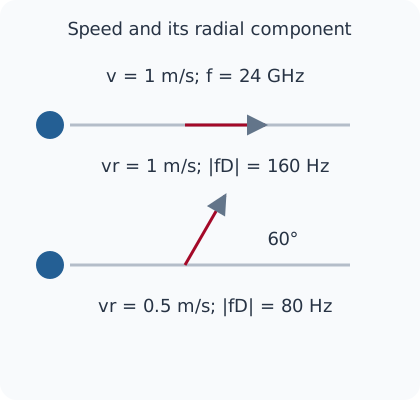
Choose a hypothetical 24 GHz carrier. Its wavelength is approximately 12.5 mm. Walking directly toward the radar at 1 m/s produces a Doppler magnitude of 160 Hz: roughly 160 cycles per second in the difference signal. This is a calculation, not a measured module output.
Now keep the same walking speed but make the direction 60° from the radar’s line of sight. Radial velocity is v×cos(60°)=0.5 m/s, giving 80 Hz. Pure transverse motion can give zero instantaneous radial velocity for the target centre. Limbs and changing geometry may still produce other motion components.
f = 24e9 Hz
lambda = c/f = 0.0125 m
v = 1 m/s: |fD| = 2v/lambda = 160 Hz
v at 60 deg: vr = 0.5 m/s, |fD| = 80 Hz
Approaching or receding?
A single real-valued output, such as a 160 Hz sinusoid, generally does not preserve the velocity sign by itself. I and Q paths provide observations separated by a quarter-cycle phase. With calibration and a defined sign convention, phase-rotation direction can distinguish approaching from receding motion.
Two channels alone do not guarantee correct direction detection. Channel order, phase imbalance, offsets, noise and software matter. A digital “motion detected” output also does not contain all the information available in raw I/Q samples.
Why CW phase does not give unique absolute range
A wave repeats every cycle. In the round-trip model, moving the target by half a wavelength changes phase by a whole turn. At 24 GHz that distance is 6.25 mm. Many ranges can therefore have the same phase, and circuit phase introduces an additional calibration problem.
It would also be wrong to say that phase contains no range-related information: small relative displacement can be tracked under suitable conditions. The limitation is unambiguous absolute range from simple single-frequency CW. FMCW and FSK add controlled frequency changes to obtain additional information.
From motion observation to a dependable decision
A prototype needs a defined speed range, mounting angle, surrounding reflectors and update interval. A stationary person produces a stationary echo, but DC rejection or AC coupling in a motion-processing path may remove it. No motion output does not establish that nobody is present.
The exercise calculates wavelength and Doppler only. It does not test stationary-person presence, direction detection or a safety system. An automatic-door application must distinguish a motion trigger from a validated safe-to-close decision.
Download the calculation
Run the Python exercise with Python 3.10 or later. It needs no extra libraries, device or network connection. The output below comes from these hypothetical calculations.
wavelength=12.5 mm; direct Doppler=160 Hz; at60deg=80 Hz
Calculated hypothetical examples only; no hardware, RF or measured-data test.
Primary sources and further reading
The explanation and examples are original editorial teaching material. These primary references support the physical principles and processing models.
Question and answer article
Ask your technical question
Questions and answers are published after moderation. Authors can see their own pending drafts.
No confirmed questions have been registered for this article yet.