Make assumptions explicit | Embedded Engineering in the AI Era, Part 4
Answer the operating-context exercise and record assumptions, dependent decisions and evidence, with room-monitor fresh-data and restart scenarios.
Contents
An assumption is something we have not yet established but provisionally use to make a design decision. Record what you are assuming, which decision depends on it, what would change if it were wrong and what evidence could resolve it. For our room-temperature monitor, “the user reads the display from one metre away” differs from “we must buy a large display.” The first describes operating context; the second chooses a solution. Selecting a component before clarifying distance and readability is premature.
This is Part 4 of Embedded Engineering in the AI Era. We first answer Part 3’s exercise, then build an assumptions record that can evolve with the project. The examples are fictional teaching material, not actual reader submissions or observations.
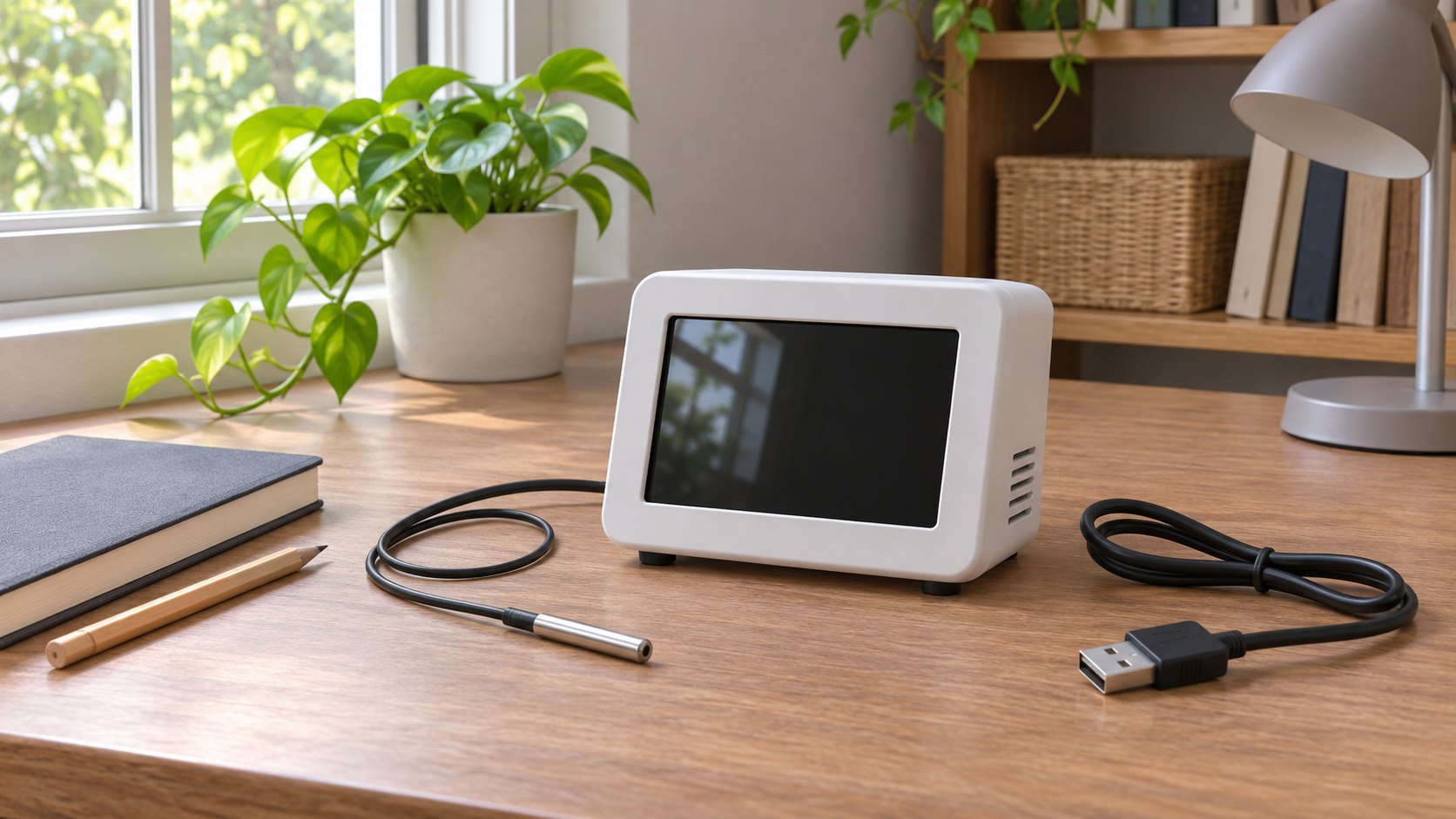
Educational illustration: LCENJ.
Previous exercise: roles, conditions and decisions
The exercise specified a person reading the display from about one metre, afternoon reflections on its surface and a maintainer occasionally disconnecting USB to move the cable. Network availability was unknown, and sample validity came from the exercise interface. Those five statements are facts within the fictional problem. They establish no age, occupation, display technology or preference for phone notifications.
The primary user wants to know whether a reading is usable when returning to the desk, then decide what to do about room conditions. The maintainer moves the cable and restarts the device, needing to determine whether it is ready for use again. One person may perform both roles, but the tasks and decisions differ.
First relationship: The one-metre viewing distance makes number and status-label readability relevant. The design consequence is to investigate size and layout at that distance. A proposed check is to place a display mock-up at the intended location and angle and ask the person to read its states. The statement alone does not determine a final font or display size.
Second relationship: Reflections may hinder reading. Investigate display angle, placement and presentation under the afternoon lighting. A reflection in the exercise does not prove that every display is unreadable; the question is what the person can correctly or incorrectly identify under those conditions.
Third relationship: Disconnecting USB makes restart behaviour important. Before the first valid sample, an old number must not appear as a normal current reading. The proposed check is a controlled power interruption and a recorded sequence of states using test inputs. Actual observations remain blank.
Two scenarios with explicit timing and outputs
Keep the previous part’s provisional model: update the output within one second after receiving a valid sample; measure age from that sample’s arrival; treat it as fresh while younger than five seconds and stale from age five seconds; change the display to invalid within the following second. These are teaching choices, not specifications for a sensor’s physical response.
Fresh-sample scenario: At time zero the device starts without a sample and displays “No valid data.” A valid 21.4 °C sample arrives at 1 s, so it must be displayed as valid by 2 s. If nothing else arrives, its age reaches five seconds at 6 s; the display must become invalid by 7 s. Age starts at sample arrival, 1 s, rather than device startup or the last screen refresh.
Power-interruption scenario: Suppose a valid number was displayed before USB was disconnected. After power returns, start in “No valid data.” Retrieving the old number from storage does not make it fresh. Show a normal number, within the one-second deadline, only after the first valid sample of this startup arrives. If the first input is invalid, remain invalid.
For the two interface states requested in the exercise, possible text is “High temperature: … °C” and “No valid data: —.” Colour is an additional cue. The high-temperature threshold is still unknown, so do not attribute a number to the user. A proposed acceptance criterion is that the person distinguishes the states from their text at the specified distance and lighting. Define the expected answer and recording method before the check; leave actual results blank.
Two new assumptions, consequences and evidence
Assumption one: The user looks at the display when a decision is needed. The exercise did not establish this. If it is wrong, improving readability alone does not solve the attention problem. Ask what event prompts the person to check the temperature. Evidence would be an account or observation of that activity in context. Inventing an “inattentive user” persona is not evidence.
Assumption two: Monitoring may pause while USB is disconnected, and losing pre-interruption history does not prevent the user’s decision. If this is wrong, continuity or historical records may be needed. Ask which decision must be made during the interruption and which past readings matter. Until that is clear, do not declare backup power or persistent storage the required solution.
A common mistake is changing “network availability is unknown” into “there is no network,” or treating the exercise interface’s supplied validity flag as a guaranteed feature of a future sensor. Unknown is not a negative finding. A model assumption is not a component specification. Likewise, the project’s earlier five-volt USB constraint does not authorize five volts on every future board pin.
How an assumptions record supports design
For each assumption, record an identifier, precise statement, origin, dependent decision, consequence if wrong, investigation and status. For example, A-01 can identify “the user looks at the display when deciding,” with “a local display is sufficient” as the dependent decision. Its present status is unexamined; later evidence may support it, reject it or restrict it to particular conditions. The record should change with evidence rather than become a list of permanent beliefs.
You need not resolve every unknown at once. Start with an assumption whose failure would change the architecture or essential behaviour. This is qualitative prioritization; multiplying guessed scores does not produce a measured failure probability or risk. The GOV.UK research-planning guide recommends turning unsupported assumptions into research questions. Here we apply that principle to attention, readability and interrupted power.
An assumption differs from a requirement. “For now, choose a one-second display deadline” is a design assumption. “Update the display within one second after receiving a valid sample” is a proposed, checkable requirement. The latter can depend on the former, but its origin must remain visible. NASA’s requirements guidance also calls for explicit, consistent assumptions whose correctness is checked.
Use AI to challenge assumptions
Provide the problem and assumptions record, asking for either a supporting input statement or an “unsupported” label for each claim. For example: “Use only this exercise. For each assumption, identify the dependent decision, consequence if wrong and one neutral question. Do not invent user answers or test results.” Compare each proposed connection with the input yourself. Fluent prose supplies no new evidence.
If AI says the user prefers phone notifications, do not accept that without evidence; turn it into a question about decision context and attention. Section 2.2 of the NIST Generative AI Profile describes confidently presented false content. In this exercise, AI can suggest and critique; it has not conducted an interview, observation or test for you.
Part 4 exercise: a decision that depends on an assumption
Retain the five fictional inputs at the start of the answer. Complete four assumptions records: the two worked assumptions above and two new ones of your own. Each needs an origin, dependent decision, consequence if wrong, question and required evidence. For one record, write two branches: which decision would fit if supported, and what must change if rejected? Do not choose a final solution ahead of evidence.
Also submit two timelines. In the first, valid samples arrive at 0 s and 3 s, then no more samples arrive. In the second, the device restarts but its first input is invalid. Apply the same five-second freshness and one-second output deadlines to identify when data becomes stale and the latest permitted display change. An invalid input does not refresh the last valid sample’s arrival time. State expected outputs and leave actual observations blank.
The English assumptions-and-decisions workbook supports documentation; your response may be in Persian or English. Check that supplied facts and new assumptions remain separate, every assumption has a dependent decision, timing starts at the correct event and no result is invented. Part 5 will answer this exact exercise and its common mistakes, then refine acceptance criteria.
Question and answer article
Ask your technical question
Questions and answers are published after moderation. Authors can see their own pending drafts.
No confirmed questions have been registered for this article yet.