Grace Hopper: from programming machines to a common language
Grace Hopper’s work in programming, documentation and common languages, with historical sources and practical lessons for embedded engineers.
Contents
Electronics History · Engineers, their lives and ideas
Grace Hopper helped make computers easier for people to program. Her contribution extends beyond translation tools: common languages, documentation and teaching addressed a related problem. How can knowledge developed by one group become useful to another?
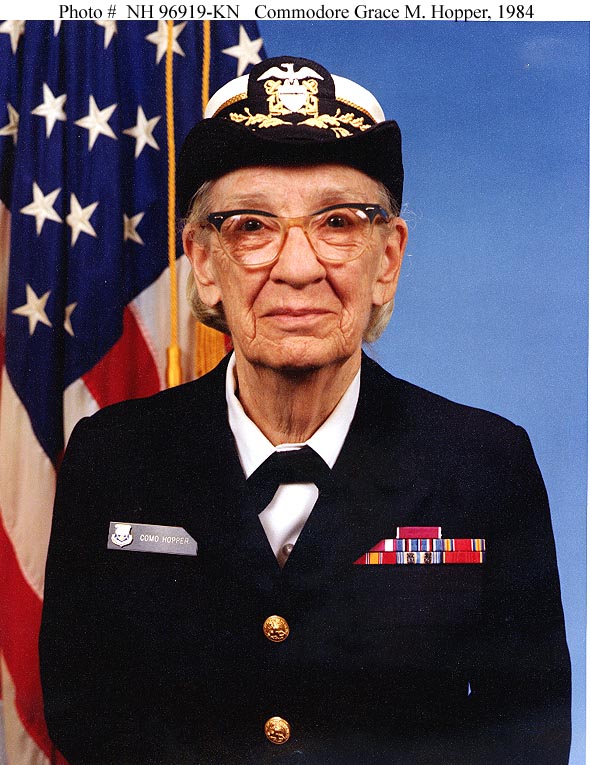

From mathematics to a working machine
Born in 1906, Hopper earned a mathematics master’s degree at Yale in 1930 and a doctorate in 1934. She taught at Vassar before her computing career. Naval Reserve service during World War II brought her to computation work at Harvard. Yale’s biography documents this transition.
The Mark I was electromechanical: electrical and mechanical components participated in its operation. Today, a programmer generally starts with an established environment. The early team also had to develop and explain ways of using its machine. Hardware, tools and working practices had not yet separated into their familiar modern forms.
Making experience transferable
In her 1980 interview with Angeline Pantages, Hopper recalls copying pieces of code from colleagues’ notebooks, an early form of routine reuse. She also describes being assigned to write a book about the machine. These are accounts of particular experiences, not proof of every trait attributed to her.
Our interpretation for embedded engineering is practical. If only one person knows how a sensor must be configured, the project depends on that person’s memory. Pins, units, startup order and recognizable errors belong in a handover. This is a present-day example, not a claim that Hopper wrote instructions for modern sensor boards.
Compilers and readable programs
A compiler translates a program into a form a computing system can use. Early tools should not be equated uncritically with modern compilers. Hopper’s A-0 work in the early 1950s, followed by her team’s FLOW-MATIC work, formed part of the move toward more accessible programming. The IEEE Computer Society historical profile describes her advocacy of high-level languages and colleagues’ contributions to COBOL. COBOL was a collective achievement.
A high-level language hides some machine details behind usable rules. Abstraction helps programmers but does not remove physical constraints. A sensor library can offer a simple temperature-reading function while conversion time, voltage levels and communication failures still matter. This comparison is our analysis.
A standard needs more than a shared name
Standards, portability and education feature in Hopper’s interview. Readers should distinguish her speech from the editor’s historical introduction. These records show a career extending from writing programs to improving tools and working practices. Its results cannot be explained by one person’s determination alone.
For a hypothetical modern example, two devices may both report “temperature,” while one sends degrees and the other sends hundredths of a degree. A shared label is insufficient. Format, units, range and failure behaviour must also be agreed and testable. This illustrates compatibility today; it is not taken from Hopper’s projects.
Reading a debugging story carefully
The Smithsonian logbook documents a moth found in the Mark II’s components in 1947. It does not establish that Hopper personally found it or invented the engineering word “bug.” A useful lesson is to inspect the system before assigning a problem to software.
A useful legacy in everyday work
Hopper retired from the Navy as a rear admiral in 1986 and died in 1992. Her career reached beyond a single program. One way to apply this theme is to document a project so another person can operate it and recognize its expected results and errors.
Write one function’s inputs, outputs, units and invalid-result conditions, then ask a colleague to use it with only that explanation. This is our exercise, not advice attributed to Hopper. The embedded deadline tutorial offers a related example of turning a broad term into a measurable requirement.
Question and answer article
Ask your technical question
Questions and answers are published after moderation. Authors can see their own pending drafts.
No confirmed questions have been registered for this article yet.