Send a Pulse, Time the Echo: Pulsed Radar and UWB
A target fifteen metres away explains time of flight and pulse resolution, then separates UWB radar from cooperative two-device ranging.
Contents
Radar from zero — part 5 of 6
Pulsed radar transmits energy in finite time intervals and examines the echo. Echo delay is related to range. UWB describes very wide bandwidth, which short pulses can provide. UWB ranging between cooperating radios is not the same measurement as radar reflecting from an untagged object.
This lesson connects everyday situations with calculations. Numbers use the stated assumptions.
What a pulse is
Instead of leaving a torch on, imagine flashing it briefly. A radio pulse similarly occupies a finite time interval; it may contain many carrier oscillations. The start-to-start interval is the pulse repetition interval, PRI. Its reciprocal is the pulse repetition frequency, PRF.
Some receivers are blanked or saturated during transmission and need recovery time afterward. Very close echoes may then fall in an unobservable interval. Architectures differ; neither maximum range nor bandwidth alone specifies minimum range.
Fifteen metres means a 100-nanosecond round trip
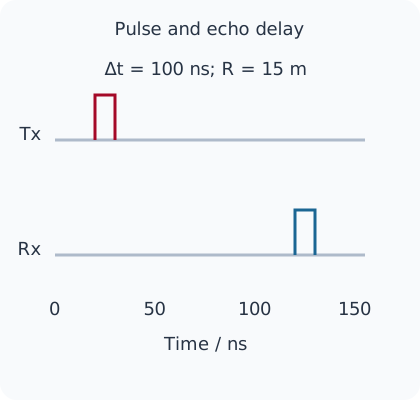
With approximately co-located antennas, a target 15 m away gives a 30 m round-trip path. Using c≈3×10^8 m/s, its delay is 100 ns, and R=c×t/2 returns 15 m. Measuring that interval requires suitable receiver and timing hardware; an ordinary development-board timer is not automatically a radar.
The diagram places the hypothetical transmit pulse at 20–30 ns and its echo at 120–130 ns. Their start times differ by 100 ns. The arbitrary time origin does not affect the result. The drawn echo amplitude is for readability, not a received-power calculation.
Short pulses and separate echoes
For a simple unmodulated pulse of effective duration τ, the range-separation scale is approximately cτ/2. A 10 ns pulse gives about 1.5 m. More closely spaced echoes can overlap. This simple scale is not a guaranteed time-estimation error.
It does not follow that every fine-resolution radar must transmit only very short, low-energy pulses. Pulse compression sends a longer pulse with suitable frequency modulation or coding and concentrates its response through matched filtering. Energy and bandwidth-dependent resolution are no longer explained by one unmodulated pulse width.
R = 15 m -> t = 2R/c = 100 ns
tau = 10 ns -> c tau/2 = 1.5 m
B = 500e6 Hz -> c/(2B) = 0.30 m
PRI = 10 us -> c PRI/2 = 1500 m (timing limit only)
UWB describes bandwidth
UWB stands for Ultra-Wideband. Very short pulses are used in many UWB systems, but the term is a bandwidth description, not a synonym for every pulsed radar or one mandatory architecture. This lesson does not substitute a particular country’s numerical definition or radio permission for the rules applicable to a real installation.
For an educational comparison, put B=500 MHz into the appropriate ideal resolution model ΔR≈c/(2B). The scale is about 0.30 m. That is different from saying that range error is always 30 cm. Estimating one path under good conditions is a different problem from separating two echoes.
A cooperating tag is not a passive reflector
A radar target need not understand a radio message: it reflects some transmitted energy. In two-way UWB ranging, two radios exchange messages. The responding radio introduces a reply delay, which the algorithm must account for. Dividing the entire message round-trip interval by two without that correction is wrong.
A UWB module designed for communication and ranging does not necessarily expose suitable data for radar sensing of untagged objects. Check the actual supported waveform, channel data and sensing modes. The cover illustrates the distinction between a sensing enclosure and a cooperating tag; it is not a product identification.
Multipath, repetition and ambiguity
Floors, ceilings and walls can add paths longer than the direct one. The earliest observable peak is not always the direct path, for example when that path is blocked. Wide bandwidth does not remove propagation physics or guarantee sensing through every wall.
In a simple identical-pulse model with a 10-microsecond PRI, echoes delayed beyond that interval can be associated with the wrong pulse. The corresponding c×PRI/2 scale is 1,500 m. This is a timing-ambiguity limit, not the detection range of a small sensor. Power, antennas, noise and target properties still determine echo detectability.
Exercise and the next question
The exercise calculates delay at 15 m, the 10 ns pulse scale and the 500 MHz bandwidth scale. No radio pulse was transmitted and no UWB chip accuracy was measured.
We have considered distance and motion. Answering “in which direction?” requires spatial information. The next lesson explains multiple antennas and why MIMO, phased arrays and FMCW are different, compatible concepts.
Download the calculation
Run the Python exercise with Python 3.10 or later. It needs no extra libraries, device or network connection. The output below comes from these hypothetical calculations.
delay=100 ns; simple pulse scale=1.5 m; bandwidth scale=0.3 m
identical-pulse timing period=1500 m; NOT a detection-range claim
Calculated hypothetical examples only; no hardware, RF or measured-data test.
Primary sources and further reading
The explanation and examples are original editorial teaching material. These primary references support the physical principles and processing models.
Question and answer article
Ask your technical question
Questions and answers are published after moderation. Authors can see their own pending drafts.
No confirmed questions have been registered for this article yet.