The FMCW Trick: Turning a Car-to-Wall Gap into a Frequency
Understand chirps and mixing, calculate the beat frequency for a three-metre gap, then follow the path to range resolution and range–Doppler processing.
Contents
Radar from zero — part 3 of 6
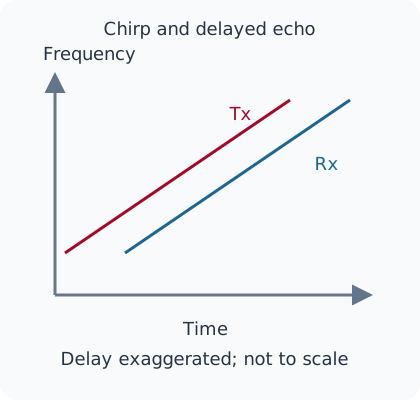
FMCW changes transmit frequency over time. An echo is a delayed version of that change. For a stationary target and a linear chirp, the frequency difference between the current reference and the echo is proportional to round-trip delay, allowing range to be calculated.
This lesson connects everyday situations with calculations. Numbers use the stated assumptions.

A chirp is a frequency sweep
FMCW means Frequency-Modulated Continuous Wave. A chirp sweeps frequency over an interval, for example from a lower value to a higher one. The amplitude need not keep increasing; frequency is the changing quantity discussed here. Down-chirps and combined patterns also exist.
A chirp diagram plots frequency against time. Its sloping line is not the radio oscillation itself: the actual carrier completes many cycles along that line. Remember this when comparing CW, FMCW and FSK diagrams.
A delayed echo becomes a difference signal
First assume the car and wall are stationary relative to one another. At any instant, the arriving echo represents an earlier part of the sweep. For an up-chirp it therefore has a lower frequency than the current reference. Mixing followed by filtering extracts a difference component, called the beat signal.
With sweep slope S in hertz per second and round-trip delay t in seconds, fb≈S×t. Substituting t=2R/c gives R≈c×fb/(2S). This approximation assumes a stationary target, a sufficiently linear sweep and an echo received within the valid sweep interval. Start-up transients and circuit delay require attention in real hardware.
Three metres: from nanoseconds to kilohertz
Choose a hypothetical sweep bandwidth B=1 GHz and chirp duration T=40 microseconds. A microsecond is one millionth of a second. The slope S=B/T is 25 trillion hertz per second, or 25 megahertz per microsecond.
A three-metre range gives a 20-nanosecond round trip. S times that delay is 500,000 Hz, or 500 kHz. Processing can examine this difference frequency instead of directly timing 20 ns. That does not make it an audio signal or mean that any microcontroller can directly read any radar; bandwidth, converters and data interfaces still matter.
B = 1e9 Hz, T = 40e-6 s
S = B/T = 25e12 Hz/s
R = 3 m -> t = 20 ns
fb = S t = 500000 Hz = 500 kHz
DeltaR ~= c/(2B) = 0.15 m
Can two nearby reflectors be separated?
For a suitable sweep and processing, ideal range resolution is approximately ΔR=c/(2B). At B=1 GHz the scale is 0.15 m, or 15 cm. It is not a guaranteed measurement-error bound. Windowing, signal-to-noise ratio, unequal echo powers and multipath affect actual separation.
Two reflectors at 3 m and 3.05 m should not be declared separable on this specification alone. Zero-padding before an FFT displays more samples of a spectrum; it does not increase physical bandwidth or magically separate two targets.
An approachable view of the FFT
An ADC samples the beat signal: it turns its value at known times into numbers. The FFT efficiently finds frequency contributions in that sequence. Under the stationary-target assumptions, a frequency peak can be mapped to range. An individual ADC sample is not itself a separate distance.
With several chirps, phase changes within a range region can also be analysed across the chirp sequence to obtain Doppler information. Fast time describes samples within a chirp; slow time describes the sequence of chirps. They are data dimensions, not mysterious kinds of clock.
Motion and the velocity trade-off
For a moving target the beat frequency contains a Doppler contribution as well as a delay contribution. Applying the stationary-target formula blindly can shift the range estimate. Appropriate repeated chirps, sweep patterns and processing help separate the effects.
As a separate multi-chirp example, assume a 60 GHz carrier, λ≈5 mm, chirp start-to-start interval Tc=50 microseconds and N=128 chirps. For a target remaining within a range region, the velocity-resolution scale λ/(2NTc) is about 0.391 m/s. Simple phase sampling gives an approximate unambiguous interval |v|<λ/(4Tc)=25 m/s. These are simplified single-transmitter limits; MIMO timing, motion coupling and processing can change the applicable model.
What has actually been checked?
The exercise calculates slope, delay, beat frequency and resolution scales, then recovers range from the beat frequency. It does not use measured ADC data, an RF simulator or a vehicle radar. A real design must address IF bandwidth, sampling, chirp linearity, calibration and the reflecting scene.
Maximum measurable range does not follow from the resolution formula alone. Even an echo within the receiver’s frequency limits may be too weak to detect. Maximum range, resolution, accuracy and minimum range are different specifications.
Download the calculation
Run the Python exercise with Python 3.10 or later. It needs no extra libraries, device or network connection. The output below comes from these hypothetical calculations.
slope=2.5e+13 Hz/s; delay=20 ns; beat=500000 Hz; recovered=3 m
ideal range scale=0.15 m; velocity scale=0.390625 m/s; simple speed bound=+/-25 m/s
Calculated hypothetical examples only; no hardware, RF or measured-data test.
Primary sources and further reading
The explanation and examples are original editorial teaching material. These primary references support the physical principles and processing models.
Question and answer article
Ask your technical question
Questions and answers are published after moderation. Authors can see their own pending drafts.
No confirmed questions have been registered for this article yet.