ESP32 vs STM32: Choosing a Microcontroller for Your Project
Compare the classic ESP32 and the STM32F103C8 with a requirements table and two sample projects; Measure wireless connectivity, timers, memory, consumption and development tools separately.
Contents
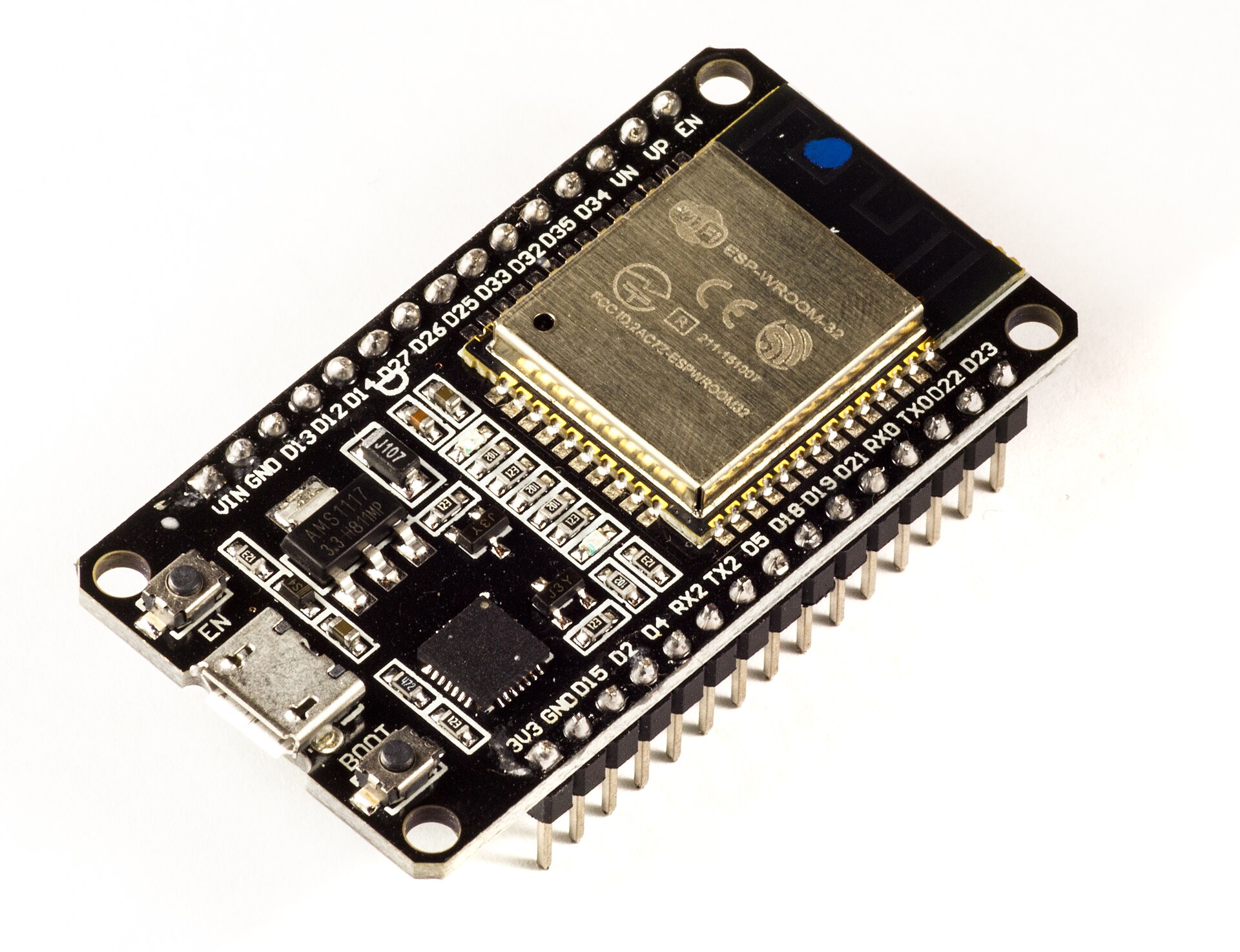

Short answer: start with the project requirement
If the project needs to connect to Wi-Fi and BLE without additional modules, a suitable board from the ESP32 family is worth checking out. If the main concern is local control, timers and specific I/O, a suitable STM32 can also be a good choice. But the names of these two families are not enough to make a final decision: ESP32-S2 does not have built-in Bluetooth, and not all STM32s are similar to F103. Write the full chip model, board and tool version.
In this guide, the numerical comparison is only between ESP32 classic and STM32F103C8. The goal is not to declare a permanent winner; We want to find out which limitation will stop your project first. The price and availability of the day or the speed test on the physical board are not claimed in this article.
A comparison table that preserves the boundary of models
| Criterion | Classic ESP32 | STM32F103C8 |
|---|---|---|
| Processor | Xtensa LX6 single/dual core models; Up to 240 MHz depending on the model | Cortex-M3; Up to 72 MHz |
| Internal memory | 520 KB SRAM; Not all of that RAM is free for the program | 20 KB SRAM and 64 KB Flash for C8 |
| Internal radio communication | Wi-Fi band 2.4 GHz and Bluetooth Classic/LE | It does not have built-in Wi-Fi and Bluetooth |
| Wired communication path | Model dependent digital interfaces and free board pins | USB, USART, SPI and I2C with pin restrictions and resource sharing |
| decision criterion | See network performance, software stack and power budget together | Consider the timer, memory and the need for an additional communication module |
Numbers come from ESP32 datasheet and STM32F103x8/xB datasheet. The number 128 KB does not belong to all models of this document; Design for C8 on the official capacity of the same part.
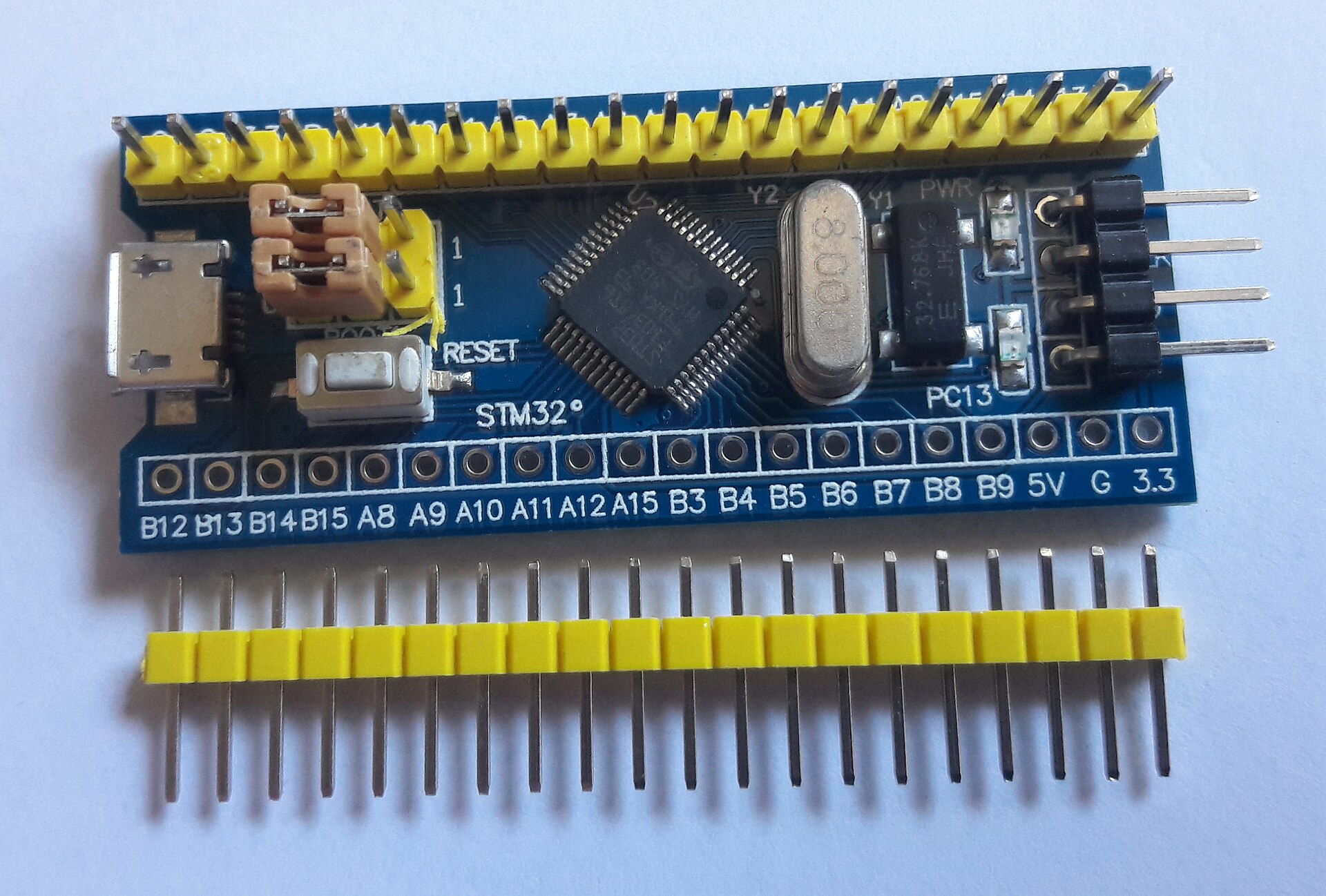

The first project: thermometer connected to phone and network
Suppose SHT31 is read every two seconds, the data is seen on the phone and if there is a network it goes to the server. First write the data contract: temperature, humidity, validity status, sample number and time of last successful reading. A Wi-Fi outage should not stop the sampling time indefinitely, and a corrupted reading should not display a valid zero.
In this scenario, ESP32 can reduce the number of communication parts. The cost is connection management, stack memory, and consumption spikes when sending. Choosing simply by the MHz number does not indicate this cost. To get started, read SHT31 tutorial and Setting up BLE on ESP32 together.
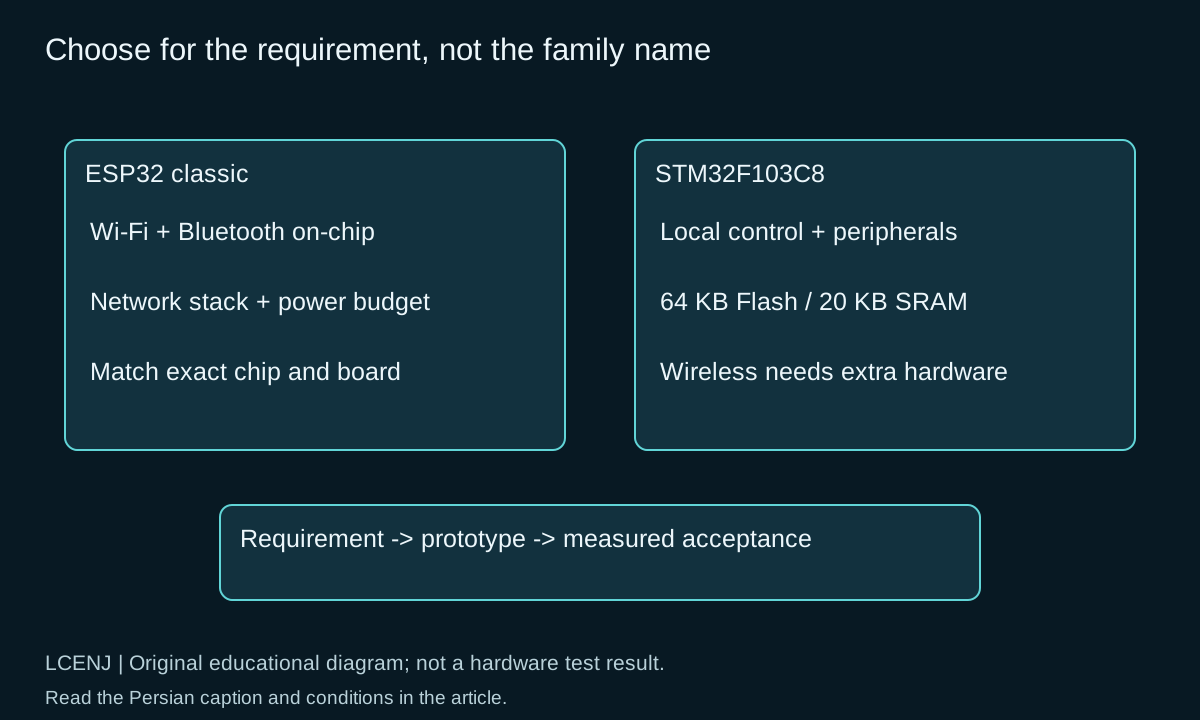
The second project: local control with scheduled output
List the number of independent timers, capture and PWM channels, interrupt behavior, and output error mode to control a low-voltage actuator. A small STM32 may cover all needs; It may not have enough memory or timer. Replacing the board with a more powerful model will not answer the question without checking the pin mapping.
Do not take power output directly from GPIO. First, specify the behavior of Reset and power cut; Then select the driver and load protection. Article Practical MOSFET and the guide What Is PWM? Arduino Frequency and Duty Cycle Examples They are complementary to this section.
Fill out the requirement table before purchasing
| hypothetical need | The acceptable limit of the project | Acceptance evidence |
|---|---|---|
| Sensor registration | One valid sample every 2 seconds | Record the sample distance and data age |
| network return | After disconnection, limited and visible effort | Event report and attempt counter |
| control output | Default mode is off | Check Reset and reboot |
| memory | Adequate margin in the worst case | Consumption report with active network and log |
| power | Fits real source and battery | Separate measurement of sleep, processing and sending |
The values in this table are design examples. Change the limit for your own project and compare the same firmware version on real options. One test with off log and another with heavy log is not a fair comparison.
See chip, module and development board separately
It may be that the chip has an interface but the required pin is not exposed on the board or it is connected to Flash, LED or other part. The module also has antenna and power limitations. The number of pins printed on the sales page is not the number of free GPIOs suitable for the project.
Also account for battery consumption, power LED, regulator and expansion board USB converter. The sleep current written in the chip datasheet does not guarantee the total consumption of a DevKit. guide Why does ESP32 reset? Brownout and power troubleshooting To check the power supply and how to read the datasheet? From absolute limit to part selection helps to read specification conditions.
Common questions and next steps
Is ESP32 always faster?
Clock number alone does not determine application response time, interrupt latency, or interface speed. Compare the same actual work with the specified constraint.
Do all ESP32s have the same Wi-Fi and Bluetooth?
No; Check the exact model, module and stack version capabilities. The family name does not replace the attribute table.
Is a cheaper board always enough for a simple sensor?
Only after checking memory, pin, source, error and development tools. A cheap part can result in higher module cost or development time.
Next step: fill out the requirements sheet that comes with the article, implement a required feature, and test against the same benchmark on the target hardware.
Official sources and accompanying files
Technical resources were reviewed on 10/13/2026. Match the version and model of your part with the related document.
Get the decision sheet and test registration (CSV); The full package of the article and accompanying files are available from the download section of this page.
Compilation method: preparation and technical review with the help of artificial intelligence tools, official sources and computational examples. Hypothetical numbers are labeled as examples; Compilation or software testing does not replace real part and circuit testing.
Question and answer article
Ask your technical question
Questions and answers are published after moderation. Authors can see their own pending drafts.
No confirmed questions have been registered for this article yet.