Jack Ganssle: from a simple radio to teaching engineering judgement
Jack Ganssle’s life and documented professional habits: debugging tools, measurement, writing and products. The opening profile in Electronics History.
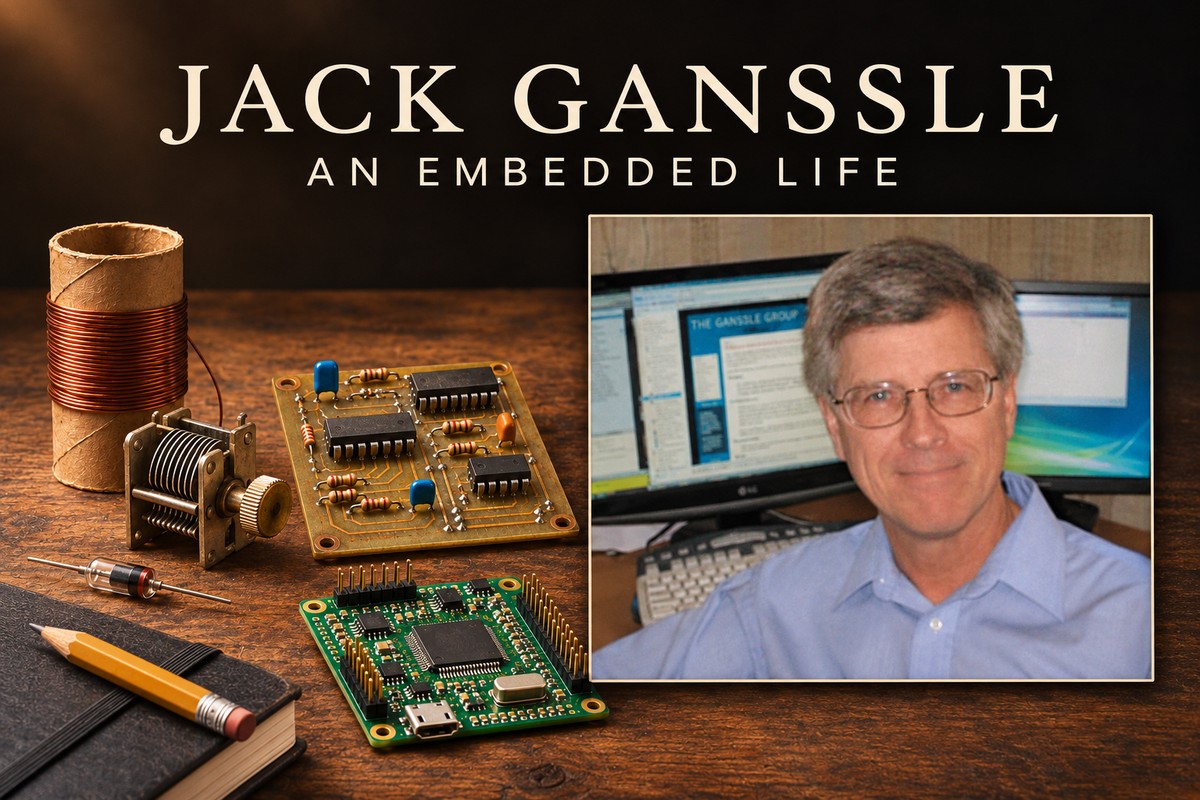
Contents
Electronics History · Engineers, lives and ideas
Jack Ganssle is an embedded engineer, author and teacher whose path began with a simple radio and later included tools that helped other engineers find faults. His story is interesting for more than its prominent project names. His interviews show how the pleasure of building developed into concern for measurement, documentation and the way engineering work is organised.
An embedded system is a computer inside a device, carrying out a particular task: reading a sensor and controlling a display or motor, for example. You do not need prior firmware experience to follow this biography. Its central thread is the relationship between circuits, software, tools and responsibility for a delivered product.

From an oatmeal-box coil to industrial work
In his 2013 Circuit Cellar interview, Ganssle describes a first crystal radio with its coil wound around an oatmeal box. A crystal radio is a simple receiver: it selects and detects a radio signal to deliver AM audio to an earpiece. That short explanation is ours; this article has not examined the schematic of his childhood receiver.
In his 2012 EDN interview, Ganssle describes becoming a technician at sixteen, working on Apollo ground-support equipment, then moving into embedded design. Ground-support equipment is different from flight computers or lunar-landing software; his account is not extended to those roles here.
The useful lesson is not that a beginner must have been a childhood prodigy. A small circuit offers direct feedback: audio appears or does not; an altered connection changes the outcome. A bounded project with an observable result can still be a better starting point than collecting tool names. One person's career, however, is not a universal employment formula.
From personal experience to deliberate learning
In the same EDN interview, he also describes reading electronics and software books. Our teaching interpretation is that practical experience and study should question each other: theory explains an expected behaviour, and experiments examine how well the assumptions fit a circuit. A biography alone is not a prescription for another person’s education or career.
Why building debugging tools mattered
In EDN, he recalls running an ICE company. To understand an in-circuit emulator, imagine stopping a board’s program and inspecting its state. In the generation described, the tool connected in place of the target processor. This close relationship with the board made debugging a problem shared by circuitry and software.
He recalls a seventeen-IC emulator with highly complex firmware. Fewer components therefore do not automatically mean a better design. Firmware is the software closely connected to a device’s hardware; a circuit saving can transfer cost into its development and maintenance.
Consider a hypothetical design change that removes one component but increases debugging time for each device. The component's purchase price is only one term in the decision. Production quantity, development effort, test and support also matter. This is our explanation of the trade-off, not a calculation of his company’s costs or profits.
Prominent projects, with a clear boundary on the claims
In Circuit Cellar, he describes White House security work during Reagan’s presidency. This is his own account. We have not examined project records or the system’s technical details, and do not credit him with designing the entire system.
Prominent names make a career memorable, but explainable behaviour offers more to a learner. Saying that someone worked on a project still leaves questions about role, scope and evidence. The same precision applies to a small project of our own: building one part of a prototype and delivering a complete product are different accomplishments.
Five professional habits supported by his published accounts
1. Write the experience down
In EDN, he stresses writing clearly and recording work. Our practical suggestion is to record the symptom, hypothesis, change and result together. “Fixed” is an inadequate handover note: the next person needs to know what was checked and what remains unknown.
2. Include the circuit in the investigation
He describes electrical faults affected by connecting an ICE. Our interpretation is to take debugging beyond staring at source code. If a prototype works only with a particular cable, its cause remains unresolved. Separate supply, connections, timing and the instrument’s influence through tests. This is a suggested investigation method, not a diagnosis of an actual board.
3. Turn an attractive claim into a checkable experiment
In Circuit Cellar, he describes battery-discharge experiments. Those experiments and results belong to him; we have not reproduced them. Our general recommendation is to avoid carrying a number from one operating condition into another product without checking it. A battery-powered device needs a defined load profile, environment and end-of-service criterion. Its board name alone cannot establish battery life.
4. Heroic last-minute debugging is not a complete process
He argues that heroics do not scale with firmware complexity. In practical terms, our recommendation is for a team to make work reviewable, testable and repeatable. If only one person knows how a product is built, today’s speed may become tomorrow’s dependency. A repeatable method does not remove creativity; it helps keep its results deliverable.
5. Enthusiasm and exhaustion are different things
He dates founding The Ganssle Group to 1997, seeking more family time. Our interpretation is not to copy his private schedule, but to examine whether a way of working is sustainable. A plan that depends on one person’s exhaustion is fragile for both team and product.
From tools to writing and teaching
The introduction to the 2013 interview describes books, articles and Embedded Muse editing. That description belongs to its date; it cannot establish current employment or continuing newsletter publication. This article does not determine his present retirement status.
This account rests on two identifiable historical interviews. Practical examples and their application to present-day working methods are editorial analysis. The aim is to distinguish a person’s account of experience from teaching explanations and independent project records. An engaging story does not remove the need for that distinction.
What can an engineer in the AI era take from this?
We found no specific statement about today's generative tools in the sources reviewed. The connection here is our editorial interpretation: recording assumptions, examining circuits, testing claims and reviewing results do not become less useful when code can be produced quickly. A fluent explanation still raises questions about its document revision and the test that could show it to be wrong.
To turn the story into practice, describe one recent fault in four lines: “What did I observe? What did I assume? What did I change? What evidence do I have?” If the last line is empty, the next step is clearer. This is our suggested exercise, not a Ganssle assignment or quotation.
For a beginner's route into this way of thinking, Part 1 of Embedded engineering in the AI era starts with problem definition and a checkable exercise. This biography begins our weekly Electronics History series. The next subject will be selected after source review.
Question and answer article
Ask your technical question
Questions and answers are published after moderation. Authors can see their own pending drafts.
No confirmed questions have been registered for this article yet.