Power Bank Usable Capacity: mAh, Wh and Phone Charge Estimates
Separate nominal battery energy from USB output, convert mAh to Wh, estimate phone charges and define an interpretable discharge measurement.
Contents
Convert a power bank’s mAh rating to Wh using the battery’s stated nominal voltage, then account separately for the energy delivered at its USB output. A hypothetical 10,000 mAh rating at 3.7 V represents 37 Wh of nominal energy. Assuming that 85% of that nominal energy reaches a fixed 5 V output gives about 6,290 mAh at USB. This is a worked calculation, not a discharge test of a product.
This guide explains why the battery label and a USB meter show different numbers, how to estimate phone charges, and how to define a useful measurement. Start with our electronics learning path if voltage, current and power are new to you.
1. Separate current, charge, power and energy
| Unit | Meaning | Hypothetical example |
|---|---|---|
| mA / A | Current at a particular moment | 2 A = 2,000 mA |
| mAh / Ah | Transferred electric charge; voltage is also needed to compare energy | 10,000 mAh = 10 Ah |
| W | Power: the rate of energy transfer | 5 V × 2 A = 10 W |
| Wh | Energy: one watt sustained for one hour | 10 W × 2 h = 20 Wh |
A milliamp-hour rating is not a charging speed. Equal mAh ratings do not necessarily represent equal stored energy when their voltage references differ. A higher wattage does not establish greater energy storage either: a source may deliver a smaller energy reserve at a higher power.
2. Read the voltage reference before converting mAh to Wh
Find the battery capacity, nominal voltage and, where provided, Wh rating for the exact model. Do not substitute the fully charged cell voltage or the USB output voltage for the nominal battery voltage. Nor should you assume every product uses 3.7 V: an official NITECORE specification, for example, uses 3.85 V. That source illustrates how to read a rating; it is not a recommendation or our test of that model.
E_nominal (Wh) ≈ Q_label (mAh) × V_nominal (V) / 1000
10000 × 3.7 / 1000 = 37 Wh
10000 × 3.85 / 1000 = 38.5 Wh
Multiplying by nominal voltage approximates nominal energy; battery voltage changes during discharge. Prefer the manufacturer’s stated Wh and conditions when available, allowing for rounding. For a multi-cell pack, voltage and capacity must describe the same reference. Adding the mAh of series cells and then multiplying that total by the full pack voltage counts energy more than once.

3. Why a 5 V output has a lower mAh number
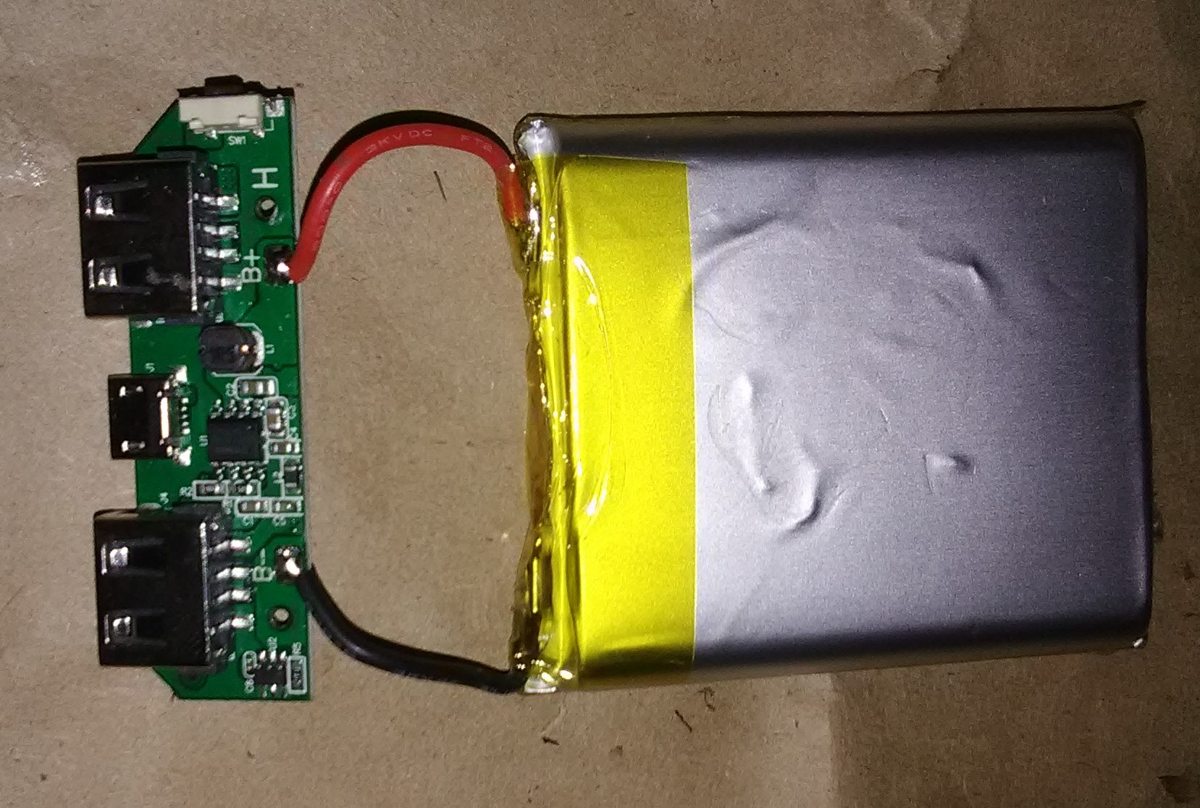
Power management transfers battery energy to a regulated output. In a common single-cell arrangement, a boost converter can raise the battery voltage to 5 V; input and output currents need not match. The TI TIDUB86 reference-design guide shows a real battery-to-USB implementation and efficiency curves that vary with load. An efficiency value at one operating point is not an all-purpose power-bank efficiency.
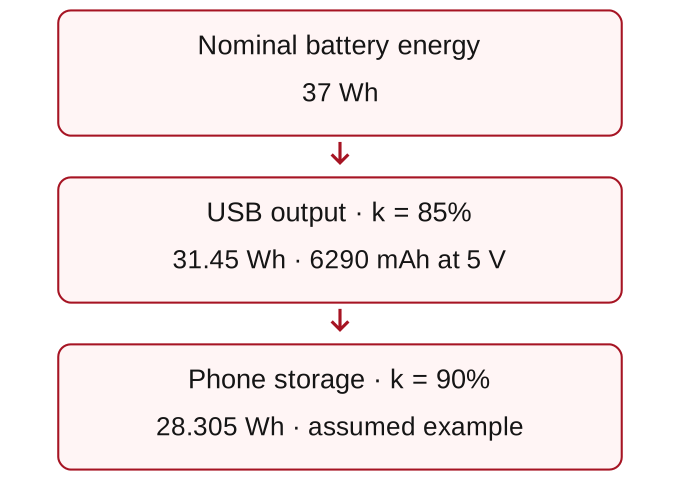
For this calculation, define k_port = E_USB / E_nominal. It describes total usable USB energy before cutoff relative to nominal battery energy. It is not just instantaneous converter efficiency: battery condition, usable operating range and circuit consumption also matter. The 85% value below is an assumption chosen for the exercise.
E_USB = 37 Wh × 0.85 = 31.45 Wh
Q_USB_at_5V = 31.45 Wh / 5 V = 6.29 Ah = 6290 mAh
Ideal lossless limit at 5 V = 37 Wh / 5 V = 7400 mAh
Even a lossless conversion cannot turn 10,000 mAh at 3.7 V into 10,000 mAh at 5 V. A smaller output mAh reading alone does not prove a counterfeit or defective product. Compare energy under stated load, temperature, ageing and manufacturer test conditions.
4. See how assumptions change the answer
These three independent assumptions all start with 37 Wh nominal energy. They are a sensitivity exercise, not a guaranteed market range or a specification for any store product.
| Assumed k_port | USB energy | Equivalent at 5 V |
|---|---|---|
| 75% | 27.75 Wh | 5,550 mAh |
| 85% | 31.45 Wh | 6,290 mAh |
| 90% | 33.30 Wh | 6,660 mAh |
If the same assumed 31.45 Wh were delivered at a constant 9 V, it would equal about 3,494 mAh. The assumed energy has not changed, but the charge number has. This does not imply that a real device has identical efficiency at 5 V and 9 V. When voltage changes through PD or PPS operation, compare Wh, or integrate power over time, instead of comparing accumulated mAh alone.
5. Estimate phone charges using energy at both ends
A hypothetical phone battery rated at 5,000 mAh and 3.85 V represents about 19.25 Wh nominal energy. Now add a separate assumption: 90% of USB output energy becomes stored phone-battery energy, with the phone’s simultaneous operating consumption neglected.
E_phone = 5000 × 3.85 / 1000 = 19.25 Wh
N_equivalent = 31.45 × 0.90 / 19.25 ≈ 1.47
The result is approximately 1.47 full-charge energy equivalents. It does not promise one complete charge followed by exactly 47 percentage points on the screen. Battery condition, temperature, the state-of-charge display, active screen/modem consumption and charging management change actual results. Keep the two boundaries separate so that you do not count phone charging losses twice inside k_port.
For a hypothetical constant 5 W USB load, runtime at the same output boundary is approximately 31.45 Wh / 5 W = 6.29 h. For an embedded board that sleeps and draws current in bursts, establish average power at the board input first. Low-load automatic shutoff may invalidate the runtime estimate. Our ESP32 brownout and decoupling guide explains why energy reserve and supply stability are separate concerns.
6. Fast-charging power is a separate specification
Battery capacity does not tell you how many watts a particular port supplies. Check USB-C, PD and PPS support and the profiles actually shared by source and device. The USB-IF explanation of USB Power Delivery describes the protocol; a USB-C connector alone establishes neither every PD capability nor PPS support. Simultaneous total output also need not equal the sum of individual port maxima.
In a purely resistive example, a cable with 0.15 Ω round-trip resistance carrying 2 A drops 0.30 V and dissipates 0.60 W: ΔV = I×R and P_loss = I²×R. These are not measurements or specifications of a particular cable. Cable loss can change both device-side measured energy and supply quality.
7. Define a measurement that another person can interpret
- Record the power-bank model and condition, output mode, cable and ambient temperature. Charge it according to its instructions. This procedure does not require opening the battery.
- Use a USB meter and suitable load with adequate voltage, current and power ratings. Stay within the power bank’s limits. Do not leave a discharge test unattended; stop for abnormal heating, swelling or damage.
- State the boundary. A meter beside the power-bank port measures source output; a meter after the cable measures energy arriving at the device side. Allow for meter consumption, voltage drop, accuracy and resolution.
- Record time and Wh from the start until output cutoff. With varying voltage, sum samples of
V×I×Δt, using hours for time. Never publish an mAh result without its voltage and conditions. - Use matching load and temperature conditions for comparisons, and do not generalize one result to every load. Measured USB energy is neither chemical cell capacity nor energy stored in a phone battery.
What was checked for this article: the equations and worked numbers were checked computationally. No discharge test, product measurement or hardware experiment was performed. See accuracy, resolution and calibration for the measurement concepts.
8. Put the right specifications together before choosing
Read nominal Wh, output capacity at its stated voltage and current, per-port profiles, simultaneous-output limits and test conditions. A bare mAh label cannot establish phone charge count. This is an energy tutorial, not a prescription to buy a particular component or model. Regional shopping: Iran. The LCENJ power-bank category contains actual store models; check each model’s current specifications and availability separately. This page’s hypothetical calculations are not test results for those products.
Sources and further learning
- TI TIDUB86, December 2015: architecture, load-dependent efficiency and output management, particularly sections 2 and 4.1.
- Texas Instruments power-bank design resources: power management and standby consumption.
- Official NITECORE NB10000 GEN2 specifications: an example of separate cell and condition-specific output ratings, not a rule for every model.
- USB-IF USB Type-C System Overview and USB Power Delivery: connector and power-delivery distinctions.
- How to read an electronics datasheet: check the conditions and boundary of each rating.
Web sources and image rights checked on 20 October 2026. These are independent educational calculations; no universal product efficiency factor is claimed.
Question and answer article
Ask your technical question
Questions and answers are published after moderation. Authors can see their own pending drafts.
No confirmed questions have been registered for this article yet.