Renesas RZ/T2N brings robot motor control, factory networking and Linux onto one chip
Renesas has introduced the RZ/T2N to combine control for up to four independent motions, industrial networking and Linux applications. A compact robot could split motion control and status logging across the same processor. Integration could reduce control components, but external motor power stages are still needed.
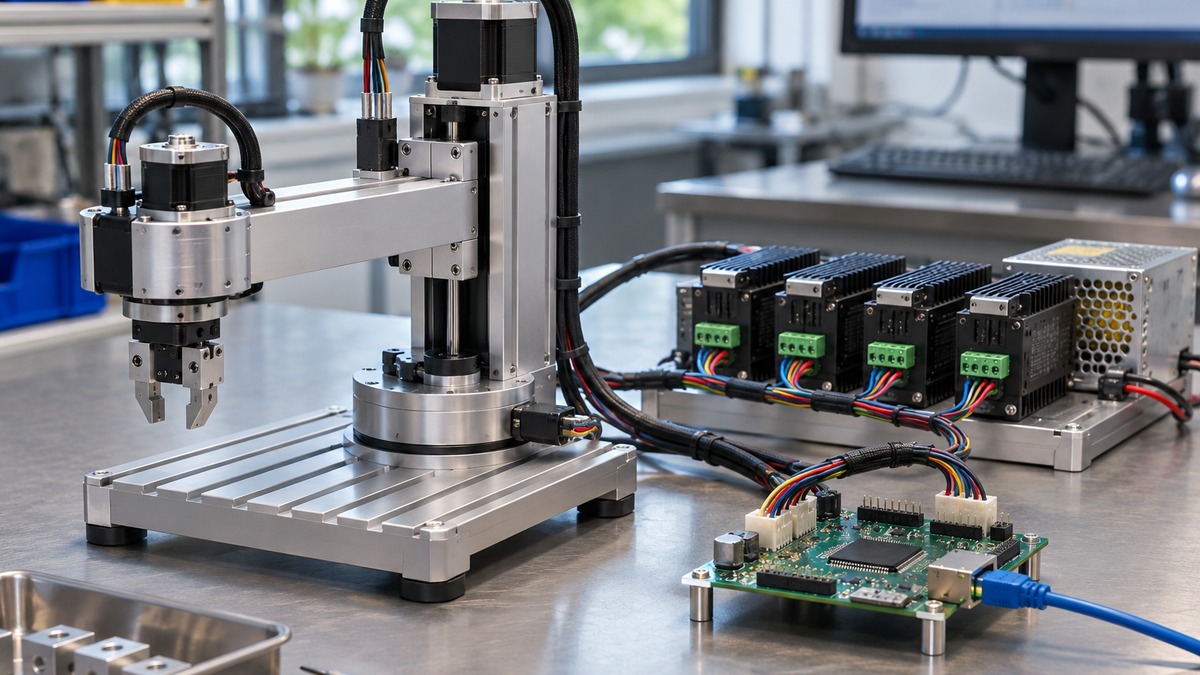
A robotic mechanism, four external motor drivers and a controller board with an Ethernet cable; conceptual illustration.
View full-size imageWhy these jobs need different treatment
An axis is an independent motion, such as rotating a robot joint or lifting an arm. Motor commands must arrive on time while other work, such as logging, continues. Renesas announced the RZ/T2N on 5 November as a way to consolidate these functions.
Separate execution resources on one processor
The announced configuration pairs two Cortex-A55 cores for Linux applications with two Cortex-R52 cores for time-critical work. A core executes instructions; assigning different work to different cores helps designers separate application processing from timely motor control. It does not by itself guarantee the response time of an entire robot.
Peripherals support motor commands and position feedback for up to four axes. Industrial Ethernet protocols, including EtherCAT, carry commands and equipment status. Designers still need external power stages to supply motor current, along with suitable position-measurement hardware.
Available hardware, future safety software
Renesas says the processor and evaluation board are available at announcement; that is not a promise of local stock. The planned functional-safety software, associated with fault handling and safe stops, is scheduled for the second half of 2027. Smaller boards and lower cost are manufacturer claims whose extent must be evaluated in a real design.