P4 Launcher runs a small device’s applications from a memory card
Gil Tal’s P4 Launcher lets supported ESP32-P4 devices select and run applications stored on a memory card. A user could leave the clock and open another app without reinstalling the device’s main software. The project remains under active development and supports specific hardware models.
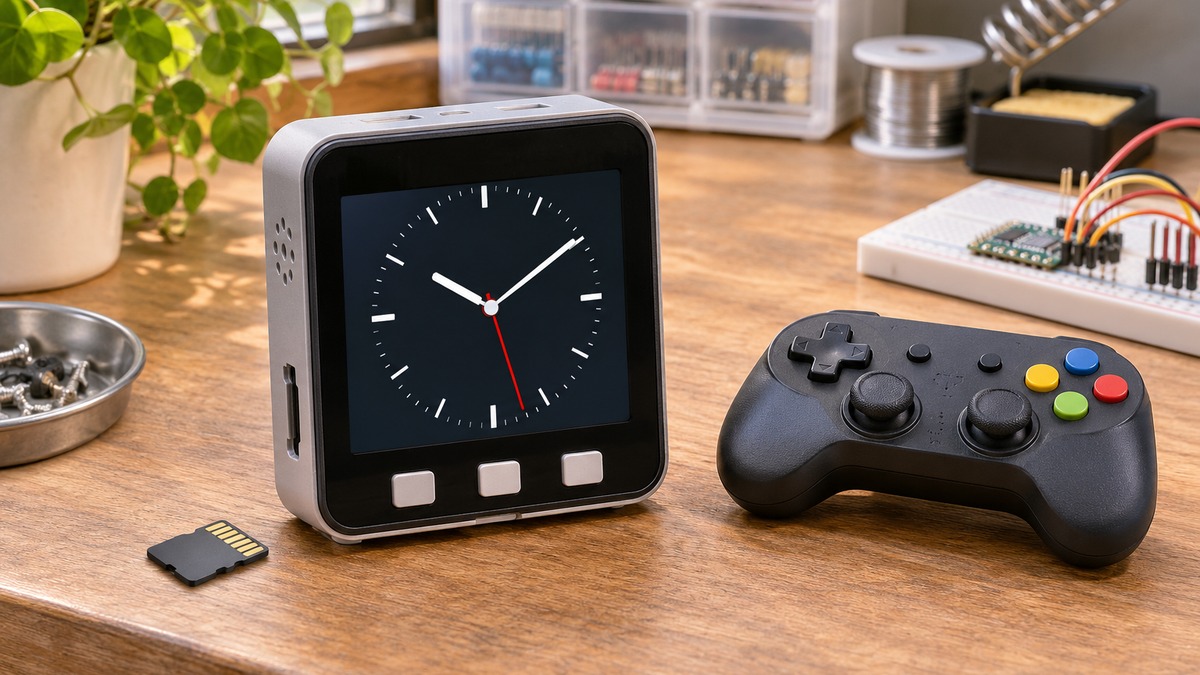
A small device showing an analog clock beside a memory card and game controller; conceptual illustration.
View full-size imageChoose a file instead of replacing the whole program
Many small-device projects require a new installation of their main software when the intended function changes. P4 Launcher keeps its launcher installed and stores applications as .papp files on a memory card. The user selects an application from a menu.
The selected file is loaded into working memory, the space used while a program runs. This project uses memory called PSRAM. When an application exits, the launcher reclaims its resources so another can run.
Support is tied to specific boards
Current documentation names three models: the 4.3-inch Guition ESP32-P4, the 7-inch Guition JC1060P470C and the M5Stack Tab5. Most supplied apps are games or emulators for older game systems; Clock and Files are also included. This does not establish support for every ESP32-P4 device.
A developing platform with important limits
The reviewed launcher version is 0.21.0. Its application interfaces are still a preview and may change, affecting compatibility. Only one application runs at a time, and apps lack protected memory separation from the launcher. An unknown app should therefore not be assumed harmless.
The original project code uses the MIT licence. Emulator cores and game engines retain separate licences, and commercial game data is not distributed with the project.