MIPS Actus brings motor control and robot-joint networking together
MIPS has detailed advances in Actus, a development platform combining motor control with communication between parts of a robot. A robot arm could use this approach to coordinate its elbow and wrist. The announcement describes a development path, rather than establishing general availability or the safety of a finished robot.
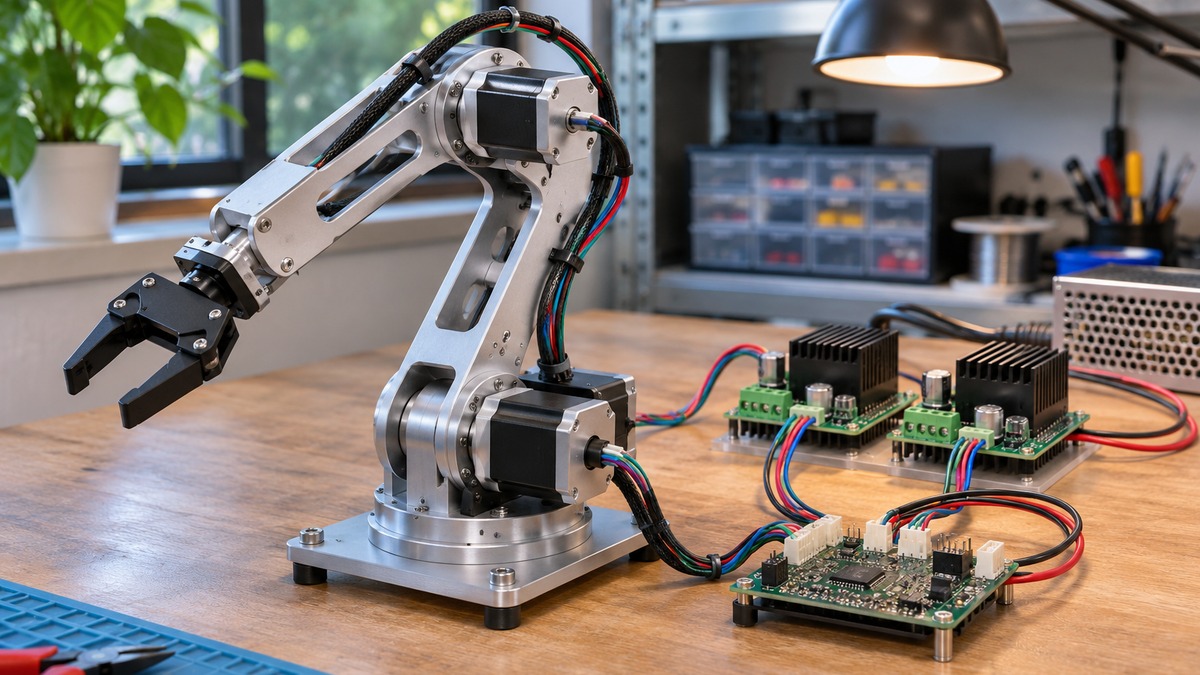
A robot arm with joint motors, wiring and separate controller and power-driver boards; conceptual illustration.
View full-size imageClosing the loop at each joint
Moving a robot arm requires more than choosing a destination. Its controller needs measurements of actual movement to adjust subsequent commands. MIPS says Actus combines two Atlas M8500 processing units, hardware assistance for motor-control calculations and networking.
Time-Sensitive Networking, or TSN, allows data exchanges to be scheduled. The aim is predictable delivery of position and motor-torque information between joints and a central controller. Achieving that requires the whole network to be designed accordingly.
A route to prototypes, not a finished robot
The 9 November announcement describes advances to Actus; MIPS first announced the platform name in September. Its proposed development path starts with a virtual software platform, followed by the Actus-1 evaluation board and programming tools. The announcement gives no general-release date.
MIPS also describes functional-safety support. Its platform page makes capabilities conditional on implementation, software and certification scope. Those statements do not establish the accuracy, safety or performance of a completed robot.