Sending wireless messages with tiny natural electrical fluctuations
Stanford researchers have shown how tiny natural electrical fluctuations can carry a wireless message. The approach could reduce the transmitter’s power needs; reporting soil moisture is one possible future use. It remains a laboratory result, and the receiver still needs power.
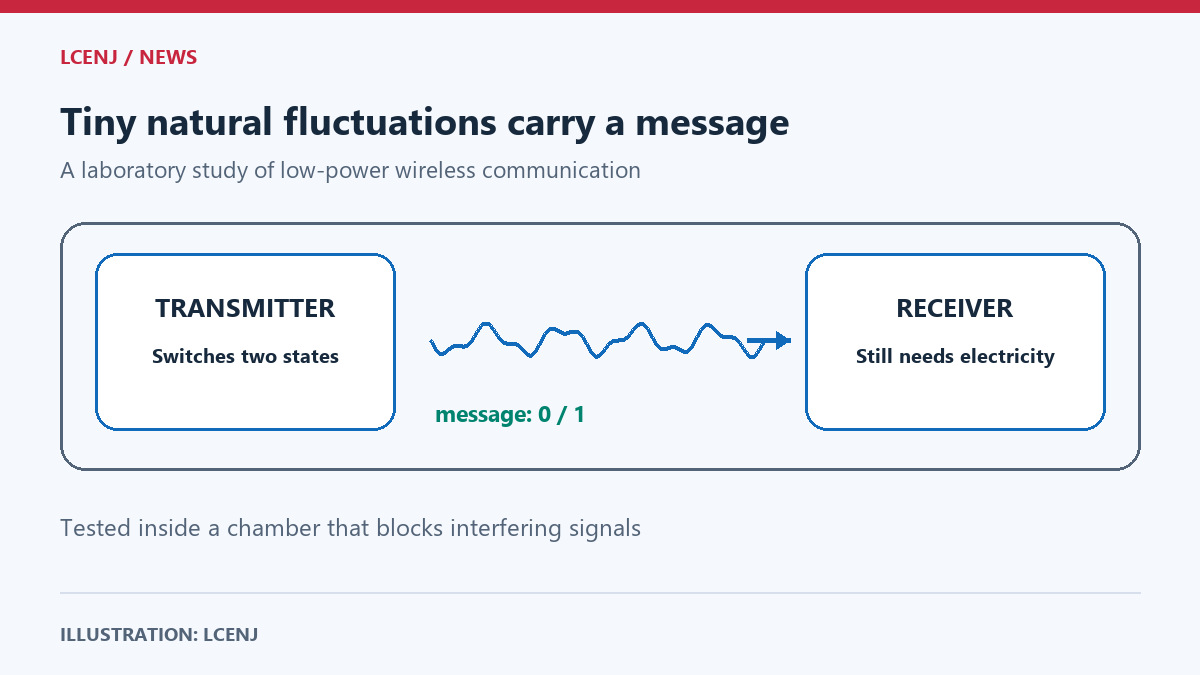
How can a fluctuation carry a message?
Electrical components have small, irregular fluctuations even without an intended message; some of these are called thermal noise. In the experiment, the transmitter switches between two connection states. The receiver detects the difference and interprets it as zeros and ones, the symbols used to build digital messages.
What is new?
The university report appeared on 19 October and the research paper online on 20 October. The new work explains the communication mechanism and how to improve it. Sending messages this way had already been demonstrated in earlier research.
What still needs testing?
The team tested inside a chamber that kept interfering radio signals out. Operation in a noisier outdoor environment and links with several transmitters are still being investigated. The possible farming use is not a deployed system or a claim of communication without any electricity.